Skincare
Sunscreen indoors: what window glass blocks, and what it quietly doesn't
UVA passes through window glass and cloudy skies still scatter it. Where desk-side sunscreen earns its keep, and the quarter-teaspoon reality of dosing.
The honest answer to “do I need sunscreen indoors” is: usually yes if you sit near a window, no if you spend the day in a blind-drawn room — and the reasoning is more interesting than either camp on the internet admits. The answer turns on which kind of ultraviolet light we are talking about, and glass treats the two kinds differently.
What glass actually stops
Window glass is a decent UVB filter and a poor UVA one. UVB, the burning wavelength, is absorbed almost entirely by standard panes. UVA — the longer wavelength tied to pigment changes and the slow breakdown of collagen — passes through ordinary glass in large measure. This is not fringe science; dermatology groups including the American Academy of Dermatology note that most of the photoaging signals people spend money on later trace back to UVA exposure, and UVA does not respect the wall between your office and the street.
The distinction matters because the sun’s damage ledger has two columns. One is sunburn, which indoor life largely escapes. The other is cumulative UVA dose, which does not require you to feel anything at the time.
Where indoor protection actually earns its keep
Two situations justify desk-side sunscreen. The first is the window seat: a workstation within a few feet of untreated glass delivers a steady low-grade UVA dose across years, and side windows in cars and trains compound it for commuters. The second is scattered light. On overcast days, a large share of ground-level UV is diffuse — bounced from sky and cloud rather than arriving in a direct beam. Sitting beside a large window on a cloudy afternoon still means sitting in that scatter. Shaded outdoor porches work the same way.
The exemption is real, though. A room where curtains stay drawn from morning to evening, with no glass in your line of sight, removes the exposure almost entirely. That person can skip the step without a lecture.
The dosing problem nobody solves
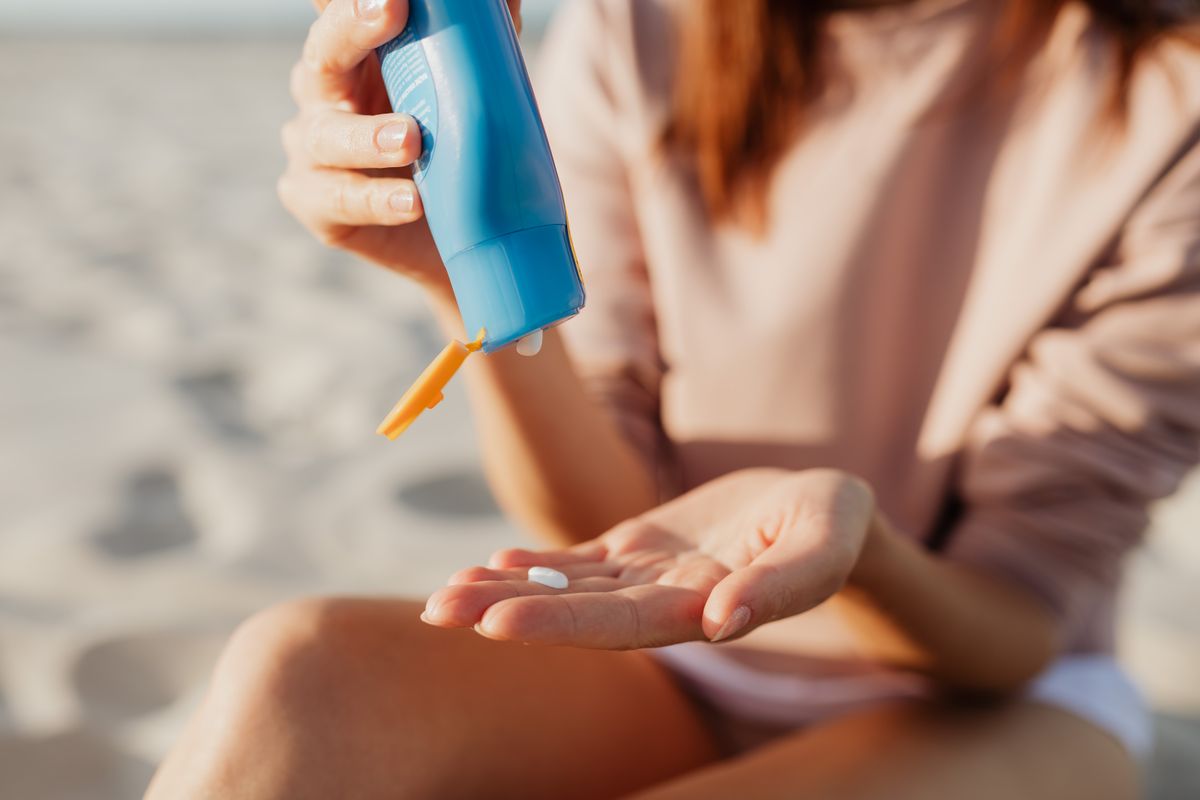
Sunscreen labels promise an SPF measured at a dose of two milligrams per square centimeter of skin. On a face, that is conventionally a quarter of a teaspoon — a strip of product along two full fingers. Published surveys of application behavior keep finding that real-world users apply somewhere between a quarter and a half of the test dose, and protection falls off roughly in proportion. A labeled SPF 30 used thinly behaves closer to an SPF 10.
This is the uncomfortable arithmetic behind “just wear sunscreen daily.” The habit is worth building, but the number on the bottle assumes an amount most people never dispense. A practical compromise: dispense the full two-finger strip indoors on window days, and treat reapplication as something you owe yourself before the commute home rather than a ritual every two hours at a desk. Our guide to mineral and chemical sunscreens covers how to pick the texture you will actually use at that quantity, and our skincare hub tracks the rest of the routine around it.
The working answer
Daily sunscreen at the full dose belongs to window seats and commutes; a sealed, curtained room earns the skip. The question is not “indoors or outdoors” but “where does the glass sit” — and, once you have answered that, whether you are willing to use the amount the label was tested at.
Frequently asked
- Do I need sunscreen if I work from home away from windows?
- In a room where blinds stay closed all day and you never sit near glass, exposure is negligible and skipping sunscreen is a defensible choice. The exemption disappears the moment a window is in your line of sight for hours, because UVA passes through ordinary glass.
- Can you get sun damage through a car or office window?
- Yes, on the UVA side. Standard glass blocks nearly all UVB but transmits a large share of UVA, the wavelength tied to pigment changes and collagen breakdown. Windshields treated for UV transmission are an exception; side and office windows generally are not.
- How much sunscreen is enough for the face?
- The dosing standard behind the SPF number is two milligrams per square centimeter, which works out to roughly a quarter teaspoon for the face alone. Surveys of how people actually apply suggest most use a quarter to half of that, which cuts the labeled protection substantially.